Make the viewing about your actual routine
A home viewing is an opportunity to gather evidence about fit. It is not an audition in which you demonstrate how well you can cope with an unsuitable environment. Before arranging it, picture an ordinary weekday and an ordinary weekend. Think about arriving home tired, preparing something to eat, storing belongings, using the bathroom, having a visitor, and leaving again. These moments produce a more useful checklist than a general question about whether the property is accessible.
Write down a small number of essentials first. These are the things that must work for the arrangement to be viable. Then add preferences and questions that would make life easier. Your list might involve turning space, sound, lighting, door controls, a place to sit while cooking, or a consistent route through shared rooms. Another person's list will be different, even if you use similar equipment or share a diagnosis.
Tell the Host how to make the viewing itself workable. You might need written directions, additional time, a quieter appointment, or particular information in advance. You can bring a trusted person if you want to, while remaining the person directing the questions and decision. There is no need to disclose your medical history to explain that you want to assess how you would use the home.
Ask for facts before making the journey
A useful first message asks for concrete details. Instead of “Is it wheelchair friendly?”, describe the feature you need to understand: whether there are steps on the route to the room, which floor contains the bathroom, or whether a door closes automatically. Ask for photographs that show the relevant route rather than only a styled view of the room. A wide photograph can reveal an approach or obstruction that a close crop leaves out.
Where measurements matter, ask how they were taken and plan to verify the details that are essential to you. A doorway measurement may be different from the usable opening with the door in place. A room's overall dimensions do not tell you how furniture affects movement. Avoid treating a number in a listing as a certification of suitability. The question is whether you can use the actual space with the actual arrangement you expect.
If the Host cannot answer something, record it as unknown. Unknown is more honest and useful than an optimistic guess. Decide whether it can be resolved before the viewing, during the visit, or through a qualified assessment. This approach also protects everyone's time: a clear answer about an unavoidable staircase may prevent an unnecessary trip, while a photograph may show that a concern is easy to investigate further.
Follow the route from the street to the room
Begin outside the building, at the place you would normally arrive. That might be a transit stop, a parking space, a passenger drop off, or the sidewalk. Follow the entire route rather than starting at the property's most convenient entrance. Notice changes in surface, gates, slopes, lighting, weather exposure, and places where other people's belongings might block passage. Ask which parts are maintained by the property and which are outside the Host's control.
At the entrance, consider the sequence of actions. Can you approach the door, operate the entry system, open it, pass through, and close it in the way you normally move? Does carrying a bag change that sequence? If you rely on a building elevator, ask about access, maintenance communication, and the practical response when it is unavailable. A working elevator during one appointment does not answer every question about day to day reliability.
Continue to the bedroom and essential shared rooms. Watch for narrow turns, doors that collide, temporary storage, and furniture that can only be moved by another person. A promise to keep the route clear is meaningful only if the household has a realistic place for everything currently stored there. The best viewing examines both physical features and the habits required to keep those features usable.
Give the bedroom more than a quick glance
Your bedroom is likely to hold more than a bed. It may also be a workspace, a place to dress, a private retreat, and somewhere to store personal equipment. Think about the arrangement after your belongings arrive. Ask whether furniture is included, what can be repositioned, and what storage is available. An empty room can feel generous while still becoming difficult to use once a bed, desk, and wardrobe are in place.
Check the controls and features you expect to use: windows, blinds, lights, outlets, heating controls, door hardware, and any communication system. Consider whether you can reach them comfortably and whether their operation is clear to you. Notice light at the time of the viewing, but ask how it changes through the day. Listen with the door closed, if appropriate, and ask what lies beside, above, and below the room.
Privacy deserves its own questions. How are repairs arranged? Who has access to the room? What notice is normally given for a household visit? These practical discussions should be followed by reviewing the applicable written housing agreement and obtaining advice where needed. The viewing checklist itself cannot establish legal rights. Its purpose is to help you identify the information you need before making a commitment.
Assess the bathroom as a sequence of tasks
A bathroom can look spacious in a photograph while being difficult to use in practice. Consider how you enter, close the door, approach each fixture, store items, and leave. Think about the routine you actually follow rather than assuming that a feature labelled accessible will fit your needs. If you use personal equipment, check its suitability with the appropriate professional and property permissions rather than improvising during a viewing.
Ask who shares the bathroom and when demand is greatest. A space that works physically may still be inconvenient if access depends on an unpredictable morning queue. Discuss where toiletries, towels, cleaning products, and equipment would be stored. A clear floor at the viewing should remain clear after everyone has showered and prepared for work. Agreeing on storage can be as important as rearranging furniture elsewhere in the home.
Do not test unfamiliar supports or attempt a risky manoeuvre to reassure anyone. Structural changes, fixtures, and equipment may require qualified assessment. Record questions about suitability instead of accepting “it should be fine” as an answer. If an essential bathroom feature cannot work for you, that is relevant information about this property. It is not a failure on your part, and you do not need to minimize it to preserve a friendly conversation.
Walk through making a simple meal
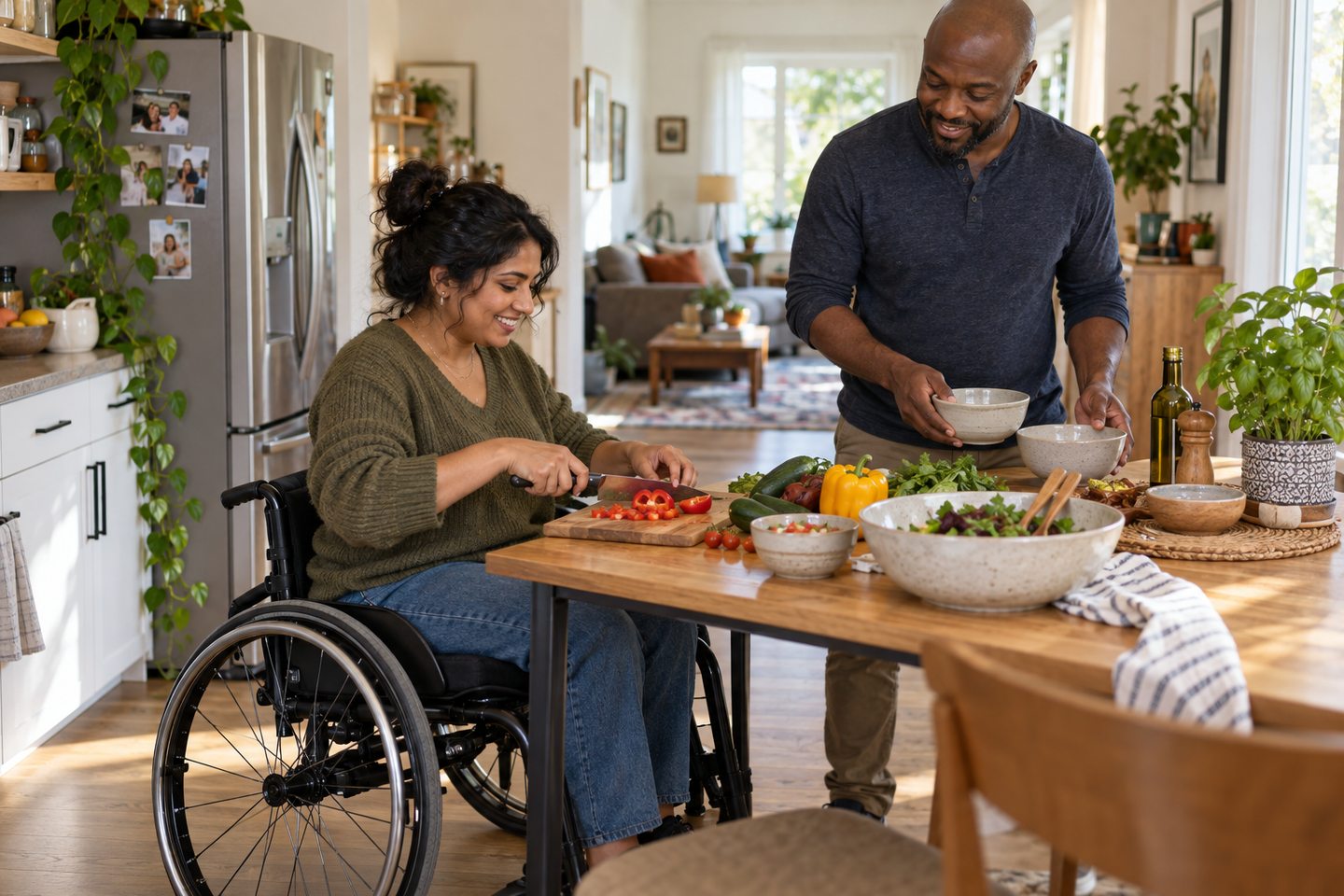
Choose a familiar meal or drink and imagine preparing it from beginning to end. Where would ingredients be stored? Could you retrieve them, reach the preparation area, use the appliance, and return items afterward? Think about carrying, opening packaging, seeing controls, hearing signals, and having enough uninterrupted space. Different people will encounter different barriers along the same sequence.
Look at the actual storage available for your use. A reachable shelf is helpful only if it is not already full or assigned to someone else. Ask whether commonly used items can stay in predictable places. Check where dishes dry, where deliveries land, and whether an open dishwasher or refrigerator blocks a route you need. If you prefer working while seated, discuss an appropriate work area without assuming a particular chair or surface will suit you.
Notice social expectations as well. Does the household cook together, separately, or both? Are there fragrance concerns, food preparation preferences, or times when the kitchen is especially busy? A kitchen is a shared working space, and access depends partly on coordination. The viewing should give you enough information to decide whether that coordination seems realistic, respectful, and consistent with the way you want to live.
Include laundry, deliveries, and everyday storage
It is easy to spend most of a viewing on the bedroom and living room, then discover that laundry involves an inaccessible basement or a long journey elsewhere. Ask where washing and drying happen, how machines are controlled, how supplies are stored, and what routes you would use while carrying or moving laundry. If an outside service is the intended solution, verify its availability and cost before relying on it.
Deliveries create another chain of practical questions. Where do parcels arrive? Is there an entry system you can use? Can groceries wait in an appropriate location without blocking a route? Who moves a parcel mistakenly left outside another person's room? These details are not glamorous, but they shape how much effort ordinary errands require. A clear routine prevents delivery bags and packaging from becoming permanent obstacles.
Think about seasonal belongings too. Coats, boots, umbrellas, sports equipment, and mobility equipment all need sensible places. Ask whether a storage plan remains workable when everyone is home at once. Do not accept a system that depends on one person's essential item always being moved out of the way. A household can keep shared spaces usable by planning storage around actual residents rather than expecting those residents to disappear from the layout.
Look for sensory and communication barriers
Accessibility is not limited to movement through a room. During the visit, consider sound, glare, scents, temperature, visual complexity, and how information is communicated. Ask what the environment is like when appliances, entertainment, and conversations happen at the same time. A quiet midday appointment may not resemble a typical evening. If a particular condition matters to you, request an additional visit or specific information rather than guessing.
CNIB's built environment guidance highlights layout, lighting, contrast, and acoustics as important considerations for people impacted by blindness. The practical takeaway for a household viewing is to examine more than floor area. Notice whether important controls are easy for you to identify, whether objects remain in consistent places, and whether changes can be communicated in a useful format. Individual preferences should guide the assessment.
Ask how the household shares information about repairs, visitors, schedules, or changes. A handwritten notice, group message, and spoken conversation do not work equally well for everyone. Discuss an approach you can actually access. You may prefer a short written summary after a conversation, an agreed place for notices, or direct communication before furniture is moved. A household that welcomes these questions offers a better basis for planning than one that treats them as an inconvenience.
Separate possible changes from completed features
A viewing often generates helpful ideas: move a table, allocate different shelves, change a handle, or improve lighting. Sort those ideas by what is already available, what can be agreed between residents, and what requires property approval or specialist work. This prevents an attractive possibility from being mistaken for an existing feature. A proposed alteration should not be counted as completed until the relevant work and checks have actually happened.
For every essential change, ask who will arrange it, who will approve it, what it will cost, and when it will be finished. Discuss what happens if the plan changes or the work cannot proceed. Keep the conversation concrete and record the answer. If an alteration affects structure, electrical systems, plumbing, or safety equipment, involve qualified people instead of treating it as a casual household project.
A useful decision note might say, “Kitchen shelf allocation agreed; entrance measurement still needed; bathroom suitability requires further assessment.” This is more informative than a single overall rating. It allows you to see whether the remaining questions are minor preferences or conditions that determine whether moving is feasible. You can remain enthusiastic about a home while being clear about the evidence needed to make a responsible choice.
Leave with a decision record, not pressure
After the viewing, review your notes away from the conversation. Group the findings into suitable, unsuitable, and unresolved. Compare them with the essentials you identified before visiting. Attractive decor, a pleasant Host, or an appealing location should not erase an essential barrier. At the same time, a modest home may be an excellent fit if the practical details and household habits match your needs.
Send focused follow up questions rather than reopening every topic. Ask for the missing measurement, confirmation of a storage arrangement, or clarification of a proposed change. Keep copies of relevant written information. If you are comparing homes, use the same set of daily activities for each so that the comparison remains about your life rather than whichever property had the best photographs.
Finally, notice whether you felt listened to. You are choosing both a place and a shared way of using it. A good match leaves room for questions, acknowledges uncertainty, and respects your authority over your own access needs. Bunking's Accessible Living community can help start that search, but the label cannot replace an individual assessment. The aim of a thorough viewing is a clear, informed decision about whether this particular household can support your ordinary day.
If you decide against the property, keep the useful lessons from the visit. A clearer description of your essentials can improve the next search. You can thank the Host for their time without apologizing for needing a home that works for you. Declining an unsuitable arrangement is a valid outcome of a careful assessment.