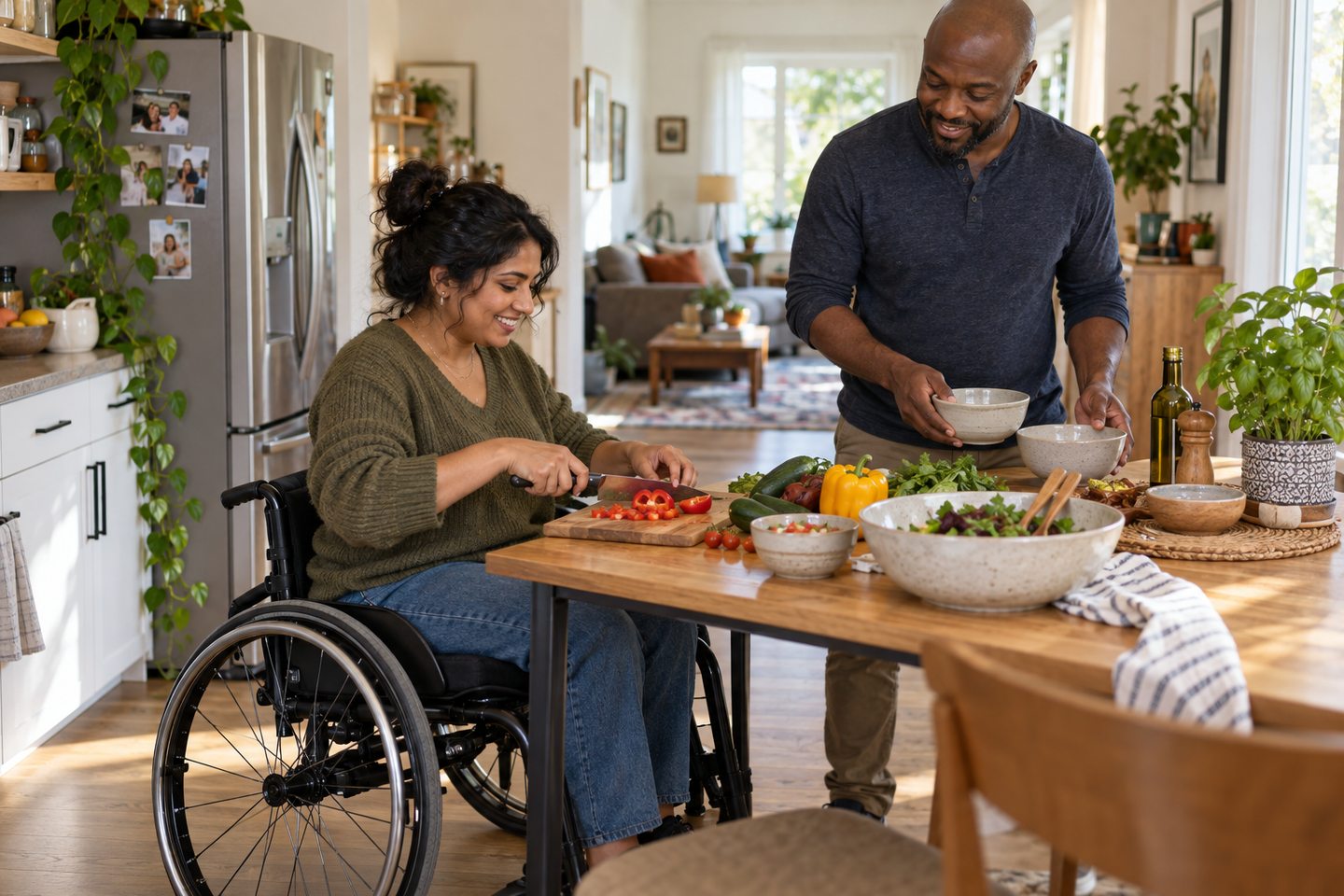
Design around the people who live there
A shared kitchen is a place to prepare food, store supplies, talk, and move through the day. When it works well, it can give Bunkmates more options: cooking independently, enjoying an occasional meal together, or simply making breakfast without negotiating a series of obstacles. Inclusive design begins with the actual people using that kitchen. It does not begin with an assumption that everybody cooks, reaches, sees, hears, stands, or processes information in the same way.
Ask each person to describe a meal they regularly prepare and the steps involved. Someone might need a place to work while seated. Someone else may value clear labels, predictable storage, or fewer simultaneous sounds. Another person may prepare food according to a cultural or religious practice that requires a particular arrangement. These needs can coexist, but they have to be made visible in the planning conversation.
The goal is not to turn every meal into a household meeting. It is to establish simple arrangements that remove repeated friction. Where an alteration or piece of equipment needs professional assessment, obtain that advice. For many daily questions, however, the starting point is a respectful conversation about storage, timing, communication, and the difference between a shared resource and a personal belonging.
Follow the meal from cupboard to cleanup
Pick one ordinary meal and trace its path. Start with receiving or buying ingredients, then consider storage, preparation, cooking, serving, and cleanup. At every step, ask what needs to be within reach, what must remain clear, and what another person might unintentionally interrupt. This exercise reveals barriers that are easy to miss when looking at a kitchen as a photograph rather than a working environment.
For example, a hypothetical Bunkmate might be able to use the preparation surface comfortably but find that the utensils are stored across the room. Another may have no difficulty cooking but struggle when freshly washed dishes are placed unpredictably. A third may prefer to prepare food before the kitchen becomes noisy. These are different problems requiring different responses. A single claim that the kitchen is accessible does not resolve them.
Try a small change and review it. Move frequently used items with everyone's agreement, allocate a clear preparation area, or establish a quieter cooking period. Notice whether the change actually helps and whether it creates a new barrier elsewhere. Household design should be responsive rather than ceremonial. The useful question is not whether the arrangement looks inclusive, but whether the people living there can use it in the ways they have agreed.
Allocate usable storage before dividing equal shelves
Equal numbers of shelves do not necessarily provide equal access. A high shelf and a low drawer may serve different people very differently. Start with which storage areas each person can use comfortably, then allocate space in a way that supports those needs. Ask about the size and type of items people actually keep. A person who cooks frequently may need different storage from someone who mainly prepares simple meals.
Separate shared staples from personal food and equipment. Label the arrangement in a format that works for the household, and keep the system simple enough to maintain. If someone changes where an item belongs, communicate the change before another person has to search for it. Predictability can save time and reduce frustration without requiring an elaborate organizational scheme. It also helps prevent an accidental rearrangement from becoming a recurring barrier.
Consider delivery packaging and bulk purchases. A large container may be economical but difficult for a resident to open, move, or store. Discuss alternatives instead of assuming that the person who can manage it will always be available. Shared purchasing should make daily life easier for the people involved. It should not create a system in which someone can only use their own groceries when another Bunkmate happens to be home.
Keep preparation areas genuinely available
A preparation surface can be technically present and practically unusable because it becomes a landing place for mail, appliances, shopping bags, or dishes. Agree on which areas must remain available and where temporary items should go instead. The agreement works best when it names a real alternative. “Do not put anything here” is difficult to sustain if the household has nowhere else to place incoming groceries.
If residents use different positions or approaches when preparing food, discuss how the space can accommodate them without constant rearranging. CMHC's overview of universal design includes adjustable features as one way to support different users. In an existing shared home, the practical question is which appropriate options are available, permitted, and suited to the actual residents. Do not improvise structural or electrical changes because an online photograph makes them look simple.
Keep routes through the kitchen in mind when appliances are open or chairs are occupied. A layout that works for one person alone may become awkward when two people are cooking. Try agreeing on work zones or staggered preparation times where helpful. This should be a mutual convenience, not a rule that always gives one resident the least desirable time. Access to an essential shared room deserves a fair and workable arrangement.
Make controls and information understandable
Appliance controls, food labels, timers, and household notes communicate important information. Ask whether each person can use the information in the form provided. Small print, unclear symbols, glare, or audio only signals may not work equally well for every resident. Avoid deciding what another person needs based on appearance. Invite them to explain the practical format or setup that helps, and follow their lead.
A household might use clear written labels, agreed tactile markers where suitable, or accessible digital notes. Changes should be compatible with the appliance and should not obscure important instructions or safety information. If an appliance is unfamiliar, consult the manufacturer's guidance and obtain appropriate help. The aim is reliable use, not a homemade modification that introduces a different problem.
Keep written household information brief. A page of complicated instructions above every cupboard can create its own barrier. Use consistent terms for the same item, put essential information where it is needed, and review whether the system remains useful. When buying replacement equipment, include the people who will use it in the decision. A feature that appears convenient in a product description may be awkward in the actual kitchen, so practical feedback matters more than a fashionable label.
Respect food, culture, and personal boundaries
Sharing a kitchen does not require sharing every ingredient, meal, or food practice. Ask which items are communal, which are personal, and what preparation arrangements matter to residents. People may have preferences connected to culture, religion, ethics, budget, taste, or health. A respectful conversation focuses on the household arrangement rather than asking someone to justify the importance of their choices.
Be precise about what the home can realistically maintain. If a person requires particular separation or handling practices, discuss those needs directly and seek appropriate advice where safety is involved. Do not make a sweeping promise that a shared kitchen is suitable for every dietary requirement. Agreement requires clarity about the actual routines, equipment, and responsibilities involved. Good intentions do not replace a workable plan.
Shared meals can still be enjoyable. Consider an occasional meal where participation is optional and each person can contribute in a comfortable way. Contribution might mean planning, choosing music, setting out suitable dishes, or simply joining the conversation. Avoid treating an invitation as a demand to cook, eat particular food, or explain why someone declines. The benefit of living together is having more opportunities for connection while retaining control over personal decisions.
Divide tasks by agreement, not assumptions
Household work includes more than visible cleaning. Someone notices when soap is running low, schedules repairs, tracks shared expenses, manages recycling information, and remembers which supplies were agreed. List these tasks alongside washing dishes and wiping surfaces. A fuller list makes it easier to distribute work fairly and prevents the person doing organizational work from becoming invisible.
Ask what each resident can reliably take responsibility for and what they are willing to do. Do not infer ability from a disability label, age, gender, or employment status. A Bunkmate who spends more time at home is not automatically available to manage the kitchen. Someone who uses a mobility aid may enjoy cooking, while a person without a visible disability may find some tasks difficult. Specific conversation is more useful than assumptions in either direction.
Fairness does not always mean identical tasks, but it does require shared understanding. Record the basic arrangement and a way to review it. If outside cleaning or another service is needed, discuss the scope and cost openly. Household tasks should not quietly expand into personal care or supervision. Accessible shared living works best when ordinary contributions are explicit and each person's personal support arrangements remain separate and respected.
Plan for busy periods and changing energy
Even a well organized kitchen can become difficult when everyone needs it at once. Ask about work schedules, regular appointments, early starts, and late arrivals. Identify the moments likely to produce congestion. The purpose is not to control everyone's timetable, but to agree on ways to reduce avoidable friction. A little information about routine can prevent repeated misunderstandings about noise, dishes, or available preparation space.
Allow for days when a person's energy or schedule changes. An arrangement that depends on everyone performing the same task at exactly the same moment may be fragile. Consider whether some tasks can be completed within an agreed window, exchanged by consent, or supported through a planned service. Flexibility should be discussed rather than assumed, so one person's unexpected change does not automatically become another person's obligation.
For example, a hypothetical household might agree that each resident clears their own preparation area after cooking, while shared supply checks happen once a week. If someone cannot complete a task, they send a clear message and propose an alternative. This gives others useful information without requiring a personal explanation. The arrangement can accommodate ordinary changes while still protecting access to the kitchen and avoiding a buildup of unspoken resentment.
Keep access intact when cleaning and rearranging
Cleaning can improve a shared environment, but the way it is done also matters. Discuss products, timing, ventilation, and where items are placed afterward. A resident may need advance notice of a strong smelling product or a noisy appliance. Another may depend on objects being returned to familiar locations. Ask what matters to the actual household rather than applying a universal rule about the best cleaning routine.
Rearranging should be a shared decision when it affects shared access. Moving a kettle to make the counter look tidier may put it beyond someone's comfortable reach. Placing a bin in a new location may obstruct a route. Even a temporary change deserves communication if it affects another person's routine. The person making the change should not assume that everyone will discover it safely and easily.
Use occasional reviews to prevent gradual clutter. Look at the places where packaging, unused gadgets, and extra dishes accumulate. Decide what belongs in the kitchen, what can be stored elsewhere, and what should not be purchased again. This is an opportunity for everyone to contribute to maintaining a usable space. It should not become a critique of one resident's equipment or essential belongings. The focus is the agreed function of the room.
Solve a small conflict before it becomes a household story
Kitchen disagreements often begin with a small event: an item moved, a surface occupied, or dishes left in an unexpected place. Address the observable problem rather than assigning a motive. “The preparation area was full when I needed it” is easier to work with than “You never care about anyone else.” Explain the effect, refer to the agreement, and propose a specific next step.
Listen for a problem in the system. Perhaps the alternative storage area is inconvenient, a label is unclear, or the shared schedule no longer matches people's work hours. A solution that removes the source of the problem is more useful than repeatedly asking everyone to try harder. Where needs conflict, look for different zones, different times, or a practical adjustment that does not erase either person's access.
If the arrangement still cannot work, acknowledge that honestly. A respectful household does not promise that every difference can be resolved through goodwill alone. Some kitchens and routines will not be suitable for a particular combination of residents. Learning that early allows people to make informed choices. The objective is a home in which everyone can use essential shared space with reasonable predictability and dignity, without becoming dependent on another person's constant availability.
A simple first week kitchen conversation
During the first week, walk through the kitchen together and confirm the arrangements that were discussed before moving. Identify personal storage, shared items, clear preparation areas, cleaning routines, and the best way to communicate a change. Test the plan during ordinary use rather than treating the conversation as a one time ceremony. A short review after a few meals can reveal practical issues that no viewing would have shown.
Choose one or two improvements at a time. For example, start by making storage predictable and keeping a preparation area clear, then review the purchase of any additional equipment. Too many changes at once can make it difficult to tell what helps. Ask every resident for feedback in a format and at a time that works for them, including the option to respond after thinking rather than immediately in a group conversation.
An inclusive kitchen does not need to look like a showroom. It needs to work for the adults who live there. When practical access, food preferences, and fair contributions are discussed clearly, the room can support independence and optional connection at the same time. That is one of the most tangible benefits of thoughtfully planned Accessible Living: ordinary routines become easier to share while each Bunkmate remains in charge of their own day.