Start with the life you want to lead
Accessible shared living begins with an ordinary question: what would you like your home to make possible? Perhaps you want a shorter journey to work, a kitchen you can use comfortably, company over coffee, or enough financial breathing room to keep attending the activities you enjoy. The answer should come from you. A diagnosis, mobility device, age, or support arrangement does not tell another person what kind of household will suit you.
For some adults, sharing a home offers a useful combination of private space and shared resources. For others, living alone or choosing a different housing arrangement works better. Accessible Living is an option to explore, not a claim that everyone with a disability should live the same way. The purpose is to widen your choices. On Bunking, Hosts and Bunkmates can start conversations about the home, the household, and the daily routines that matter to them. A community label provides a starting point for those conversations; it does not establish that every property meets every person's access needs.
This article focuses on everyday decision making. It explores potential benefits while making room for the practical questions that determine whether a particular arrangement delivers them. The strongest match is one in which you remain an adult with your own preferences, responsibilities, relationships, and plans.
Independence includes deciding how things happen
Independence is sometimes described as doing every task without anyone else. That definition leaves out much of ordinary life. People share household equipment, pay professionals for services, use transport, and ask friends for occasional help. A more useful question for a housing decision is whether you have meaningful control over your day. Can you come and go when you choose? Can you use shared rooms without needing someone to rearrange them first? Can you decline an invitation without a lengthy explanation?
A well matched household can support that control through clear arrangements. If you prefer groceries delivered, agree on a reliable place for delivery bags. If a shared appliance needs a particular setup, keep that setup available rather than treating it as a favour. If you use a support worker, discuss the practical arrangements for their visits without asking Bunkmates to take over the worker's role. The details can make daily life more predictable.
Imagine a hypothetical Bunkmate who works irregular hours and uses a wheelchair. Their priority might be a clear entrance, reachable food storage, and a quiet room for sleeping during the day. Another wheelchair user may have entirely different priorities. Asking about the person's actual routine produces better information than assuming that one feature, or one description of independence, will fit them both.
Shared resources can widen the practical choices
A household can share resources that would otherwise be paid for or managed separately. Depending on the arrangement, those might include internet, furnishings, cleaning equipment, or certain utility costs. The potential benefit is not a guaranteed saving. It is the opportunity to compare a complete shared living arrangement with the realistic alternatives available to you. An inexpensive room that requires costly transport or leaves essential areas unusable may not be good value.
Build a personal comparison using the expenses you actually expect. Ask which charges are included, which are divided, and how variable bills are handled. Consider the journey to work or study, laundry access, delivery costs, and any services you already use. Keep your personal support costs separate from household spending so that everyone understands what is being shared. Avoid assuming that someone will absorb extra work in exchange for informal rent discounts.
Resources also include time and attention. One person may enjoy researching internet plans while another prefers organizing supplies. These contributions can be useful without becoming a measure of anyone's worth. A fair arrangement identifies the tasks required, asks what each person is willing and able to undertake, and revisits the plan if circumstances change. The goal is a household that works, not an accounting exercise in who deserves to belong.
Connection without compulsory togetherness
Having someone nearby can create opportunities for ordinary social contact: a conversation while making tea, a shared meal, or a familiar face after a long day. Those possibilities can be appealing if you enjoy company but still want a private home base. They should be described as opportunities, not promises that shared housing will prevent loneliness or improve a health condition. People can feel connected in many living arrangements, and a shared address does not automatically create friendship.
Talk about what connection means to each person. One Host may imagine dinner together most evenings; a prospective Bunkmate may prefer an occasional weekend meal. Neither preference is wrong. The mismatch matters if both people assume their version is understood. Ask whether invitations are optional, whether closed doors are respected, and whether quiet periods are treated as normal rather than personal rejection.
A useful household rhythm might include one optional shared activity and plenty of unstructured space. For example, a hypothetical household could reserve Sunday afternoon for anyone who wants to plan groceries together, while everyone remains free to eat separately. This creates an opening for connection without making attendance a test of commitment. You should be able to belong to your household and still maintain friendships, relationships, culture, and interests beyond it.
Accessibility is about the whole day
A step free entrance may be valuable, but it does not tell the whole story. Think through the sequence of an ordinary day: waking up, using the bathroom, preparing breakfast, leaving home, returning with bags, doing laundry, relaxing, and sleeping. At each stage, ask what helps you use the space comfortably and what might create a barrier. Your own experience is central to that assessment.
CMHC's accessible and adaptable housing resources describe approaches to making homes usable and able to respond to different needs. Those resources are helpful background, but a general design idea is not a personal assessment of a particular room. A home can have promising features and still be unsuitable for you because of layout, controls, sound, lighting, storage, or the route outside. Exact requirements for alterations should be addressed with qualified people and the relevant property permissions.
In a shared home, daily habits matter alongside the structure. A clear corridor can become obstructed by shoes. A reachable shelf can become unusable when someone moves everything for convenience. A quiet evening can become unpredictable if visitors arrive without notice. Look for people who understand that maintaining access is part of maintaining the home, and who are willing to agree on concrete habits instead of offering vague reassurance.
Privacy is a foundation, not a reward
You do not need to make your whole personal history available to establish whether a household works for you. Begin with the information necessary to discuss the space and shared routines. You might say that written messages work better for scheduling, that an entrance must remain clear, or that strong fragrances do not work in your living environment. These are practical requests that other people can understand without a detailed account of your health.
Decide what you want to share voluntarily, with whom, and for what purpose. A friendly conversation can build trust, but friendliness does not make every question relevant. You can redirect a question by saying, “The important point for living together is this arrangement.” The same respect should extend to other Bunkmates. Avoid asking someone to explain a disability because you are curious or because their needs are not visible to you.
Private space also includes belongings, messages, visitors, and time. Agree before entering bedrooms, moving equipment, sharing photographs, or discussing another person's access needs with guests. If support workers or trusted contacts need information, let the person concerned guide what is shared. These habits help everyone know that their home is a place where dignity is routine, rather than something they must repeatedly defend.
Contribution can take more than one form
A household needs food storage organized, bills tracked, bins managed, surfaces cleaned, repairs reported, and shared decisions made. It does not follow that every person must complete the same physical tasks. Begin by listing the work that actually exists. Include the less visible tasks, such as arranging appointments, checking supplies, and keeping useful information available. Then discuss a division that people understand and can sustain.
The conversation should remain specific. “Everyone helps” sounds fair but leaves room for conflicting expectations. “We review shared purchases together, and each person takes responsibility for their own dishes using the agreed setup” gives more information. If a task cannot be covered by the household, discuss whether an outside service is needed, what it would cost, and who would agree to it. Do not quietly transfer the work to the person perceived as most available.
A hypothetical Bunkmate with limited grip strength might be happy to handle an online household order but not carry bulk containers upstairs. Another person might prefer carrying supplies to managing order substitutions. The fair arrangement depends on what those actual adults choose, not on a stereotype about disability or ability. Revisit contributions when schedules or circumstances change, and keep personal care distinct from ordinary shared household responsibilities.
Support must be explicit and freely chosen
Accessible shared living is not a substitute for personal care, medical services, or a supported housing programme. If you use assistance for personal tasks, plan that assistance separately. A Host or Bunkmate should not be assumed to provide lifting, medication management, overnight monitoring, transport, or supervision. Being friendly and living nearby does not establish competence, availability, or consent for those responsibilities.
Discuss practical boundaries before moving. Ask how outside support visits fit around access, parking, privacy, and household schedules. If a person offers occasional help with an ordinary task, make sure both people understand that the offer is specific and voluntary. A lift to the shops one afternoon should not silently become a weekly obligation. Equally, accepting a favour should not give someone decision making power over your life.
Write down arrangements that are important enough to cause problems if remembered differently. This can be a simple household note rather than an elaborate document. Identify whom to contact about a building problem, how access changes are communicated, and what each person should do if an agreed service is unavailable. For individual emergency or care planning, use appropriate professional guidance. The household's role is to respect the plan and its limits, not to invent a care system informally.
Diversity makes room for different ways of belonging
An inclusive home makes space for differences in culture, race, gender, sexuality, language, religion, age, and disability without expecting one person to represent an entire group. Shared interests can help people connect, but complete similarity is not necessary. Often the more useful question is whether people respond respectfully when another person's routine or preference differs from their own.
Discuss everyday matters that might otherwise remain hidden. These can include food preparation, religious observance, visitors, language preferences, hair and personal care products, celebration dates, and how the household handles disagreements. Avoid turning the conversation into a demand for personal disclosure. Ask what practical arrangements are important for living comfortably together, and offer your own information in the same spirit.
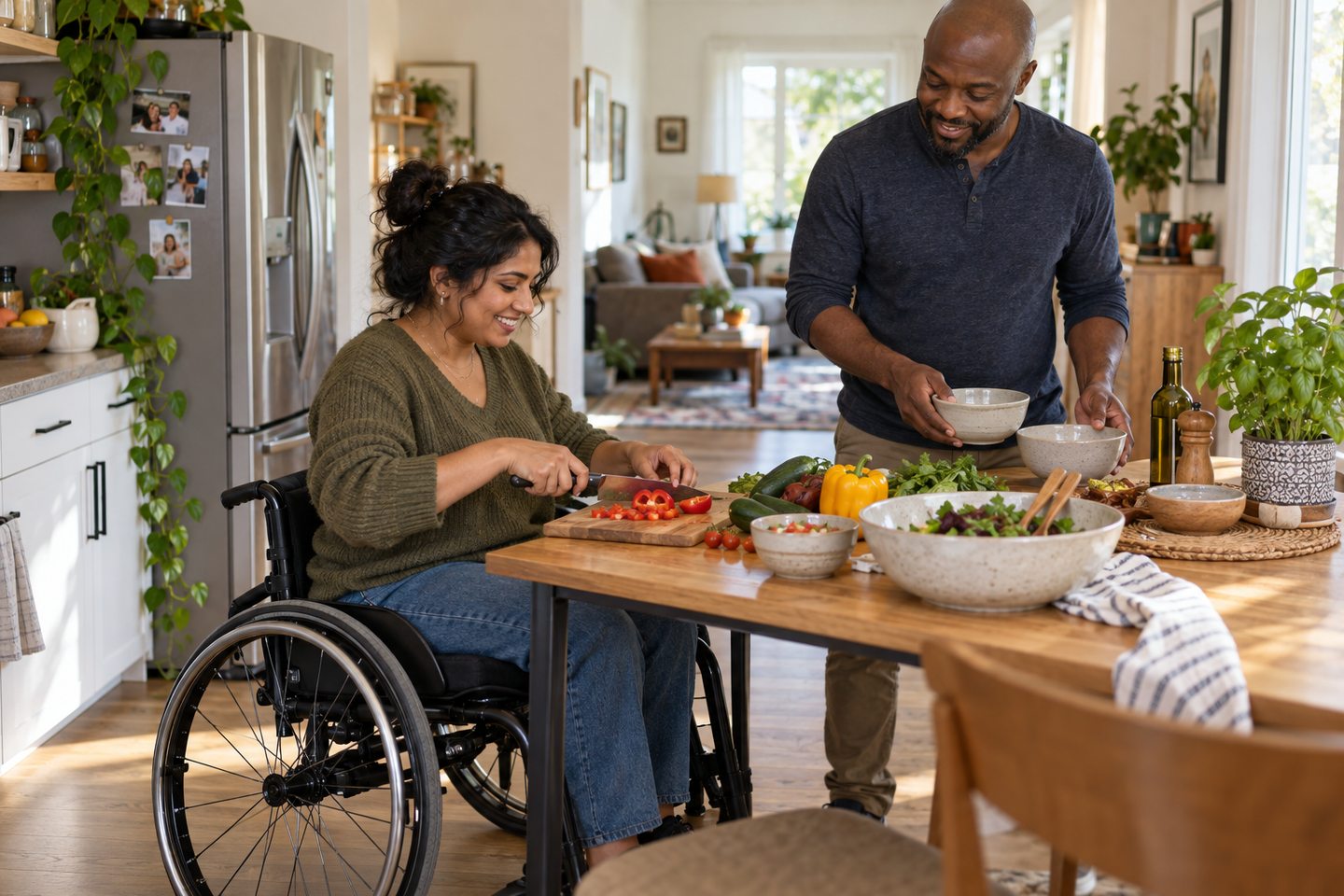
Representation also matters when describing a home. Photographs and stories should show disabled adults as people participating in ordinary life: working, laughing, cooking, creating, and making decisions. They should not imply that every accessible household looks the same. When reviewing a listing, look beyond a welcoming photograph to the details of the property and the conduct of the people involved. Inclusion becomes meaningful when respectful language is followed by usable spaces, clear agreements, and a willingness to listen.
Test the fit before relying on the promise
Approach a potential match as a shared investigation. Bring a short list of the features and habits that matter most to you. Ask for specific information, arrange a suitable viewing, and try ordinary movements or tasks where appropriate and safe. You do not need to prove that you can overcome barriers. You are deciding whether the environment supports the life you want to lead.
Pay attention to how questions are received. A thoughtful Host may not know every answer, but can be honest about uncertainty and help obtain useful information. Statements such as “we will measure that” are more valuable than unsupported claims that the home works for everyone. If an essential change is proposed, clarify permission, timing, cost, and what happens if it cannot be completed before you move.
After the conversation, compare the match with your original priorities. Separate essential requirements from preferences and appealing extras. A pleasant conversation should not erase a barrier to using the bathroom or leaving home independently. Conversely, a modest property may work very well when its practical features and household culture align with your needs. Choosing accessible shared living should leave you with a clearer sense of control, realistic expectations, and room to live as yourself.
Keep a short written record of the answers you receive, including any details still needing confirmation. This gives you time to reflect away from the viewing and makes a follow up conversation easier. A considered decision is more useful than a hurried yes.