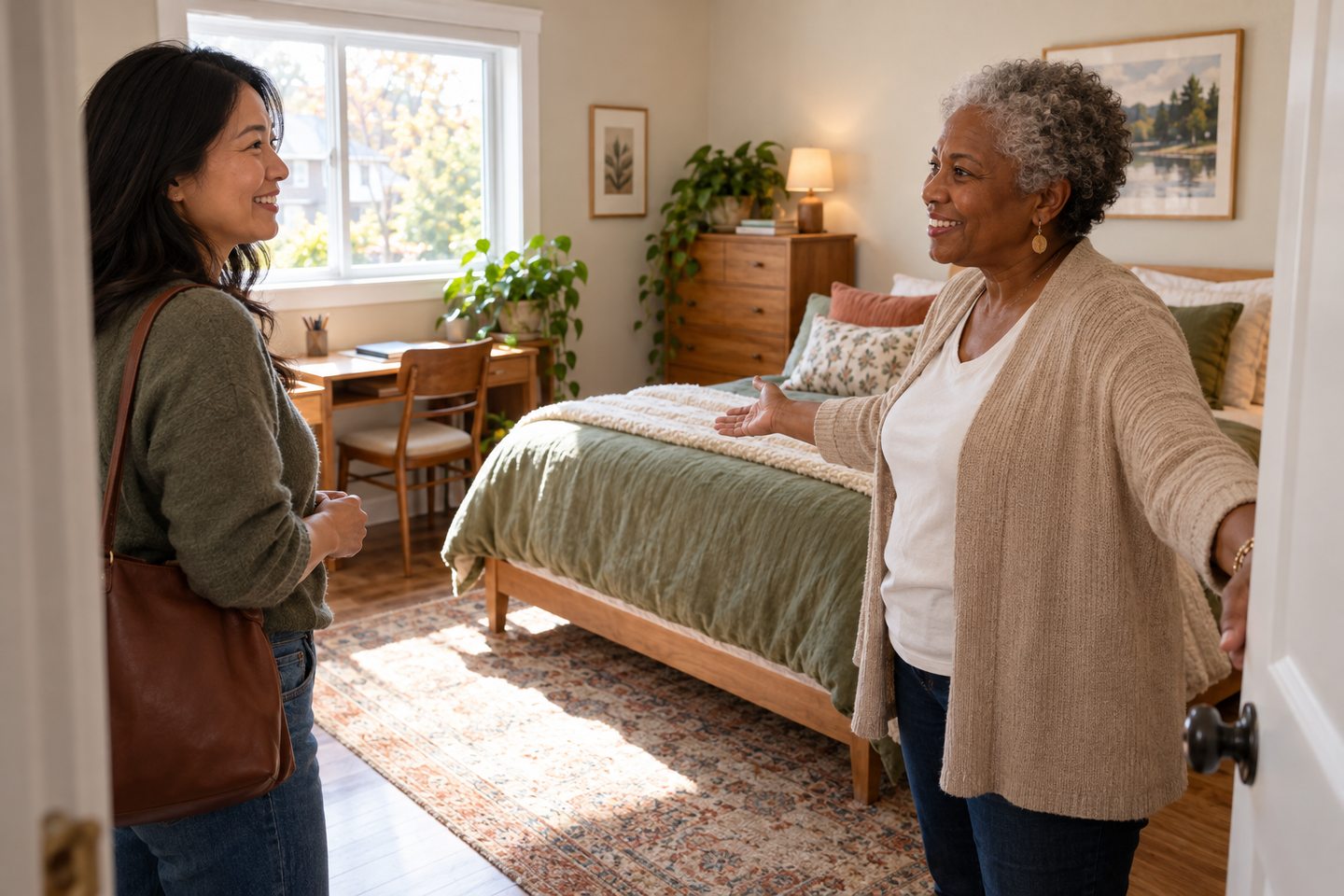
See the possibility in space you already have
An empty bedroom often has a history. It might have belonged to a child who moved out, served visiting family, or slowly become the place where spare furniture collects. Renting it out begins with a different question: could this space become a comfortable home for another person while improving how your own home works? For some homeowners, the answer opens an appealing alternative to leaving useful space idle. The benefit is not simply filling a room. It is creating an arrangement that makes sense for two independent adults.
On Bunking, the homeowner offering that space is a Host, and the person joining the household is a Bunkmate. Neither role requires an instant friendship or a shared lifestyle in every respect. A good arrangement can be friendly and independent at the same time. This article explores the practical advantages of renting a spare room, the conditions that help those advantages become real, and the questions worth answering before listing. The examples are hypothetical, intended to illustrate possibilities rather than predict income, relationships, or results for a particular home.
Put an underused part of your home to work
A home can feel full of obligations while still containing space that receives very little use. You may heat the whole house, maintain its roof, and clean its hallway while one bedroom sits untouched for weeks. Sharing does not eliminate those responsibilities, but it can give an existing room a more consistent purpose. Instead of holding possessions that could be sorted or stored elsewhere, it becomes someone's place to read, rest, work, and keep a daily routine. That can feel satisfying in a way that extends beyond rent.
Start by noticing how you actually use the room across a year. A bedroom needed every weekend is different from one used twice annually. Consider whether visiting family could use another suitable space, or whether keeping the guest room matters more to you than sharing. Avoid making a Bunkmate's home conditional on moving out whenever visitors arrive. If the space is available only for a specific period, describe that clearly and seek advice on an appropriate arrangement. The strongest benefit comes from offering space you can genuinely commit to sharing.
Create potential breathing room in the household budget
Rent from a spare room may help offset some of the costs of owning and operating a home. Depending on the arrangement, it could contribute toward utilities, maintenance, or other household expenses. The meaningful word is contribute: a listed monthly rent is not the same as money left over. Preparing the room, additional consumption, repairs, insurance changes, vacancy periods, and administration can all affect the result. A realistic estimate is more useful than an optimistic headline about earning passive income.
Build a simple worksheet using your own figures. Separate one-time preparation from recurring expenses, and include a reserve for unexpected repairs. Compare a fully occupied year with a year containing an empty period or an unforeseen cost. Speak with your insurer and a qualified tax professional about the proposed arrangement before relying on a projected surplus. This article does not calculate taxes or promise a return. Its practical point is that shared housing can create another source of household income, but the decision should remain workable when income arrives less smoothly than hoped.
Consider an alternative to moving before you are ready
Some homeowners love their neighbourhood but question whether living alone in their current house still makes sense. Moving may reduce certain responsibilities, yet it can also mean leaving familiar routes, neighbours, gardens, and community activities. Renting a room offers another possibility to investigate alongside downsizing. It may help a homeowner make fuller use of the existing property while continuing to live where their routines are established. That does not make sharing automatically better; it simply expands the choices available.
Imagine a hypothetical Host who enjoys a nearby library, walks to a favourite shop, and regularly sees friends on the same street. The upstairs guest bedroom is rarely used, and the Host is comfortable sharing the kitchen. A suitable Bunkmate could make remaining in that home more appealing. However, if stairs, major repairs, or maintenance are already unmanageable, renting a room does not automatically resolve those problems. Compare the whole living arrangement, including accessibility and ongoing responsibilities, with realistic alternatives. Preserving a familiar address is valuable only when the home continues to support the life you want.
Enjoy everyday company without scheduling every interaction
One appealing feature of shared living is the possibility of ordinary, low-pressure contact. A greeting in the morning, a conversation while making tea, or someone asking how your day went can make a home feel more lived in. Unlike a formal social commitment, these moments can arise naturally. They may be particularly welcome when work patterns change, family moves away, or retirement creates longer stretches at home. Still, companionship is a possibility created by the arrangement, not a service a Bunkmate owes in exchange for housing.
Discuss social expectations before deciding to live together. One person may welcome an occasional shared dinner while another prefers a friendly greeting and substantial time alone. Both approaches can work when understood in advance. The hypothetical Host who imagines nightly meals together may feel disappointed if the Bunkmate often works late, even though neither person has done anything wrong. An honest description such as 'a friendly household with independent routines' tells prospective Bunkmates much more than a vague promise of a family atmosphere. Make invitations easy to decline without awkwardness.
Support a housing option someone can actually use
A well-prepared room can offer another person access to a home that suits their circumstances without requiring them to occupy an entire property. They may be moving for work, studying, rebuilding routines after a life change, or simply prefer sharing. The useful contribution is specific: a comfortable private room, clearly described shared spaces, dependable arrangements, and respectful treatment. A spare bedroom does not solve the wider housing shortage by itself, but it can become a meaningful housing choice for the individual who lives there.
Think about the room through that person's eyes. Can they put their belongings away rather than live out of bags? Is there enough room to sit somewhere other than the bed? Can they reach transit or everyday services reasonably? Are the kitchen and bathroom actually available at practical times? These questions improve the offer more than calling a room 'perfect for everyone.' A smaller, honestly described space can be more useful than a larger room with unclear restrictions. Your home provides its greatest value when the Bunkmate can build a normal, dignified routine within it.
Learn from someone with different experiences
Shared living can create opportunities to meet someone whose interests, background, or experiences differ from your own. Conversation might introduce a new recipe, an unfamiliar book, another way of approaching a household task, or a local activity you had overlooked. Diversity can enrich a home through ordinary relationships, without anyone being expected to represent a culture or teach the other person. The starting point is curiosity paired with respect: ask rather than assume, and allow personal subjects to remain personal.
Compatibility is better explored through practical habits than stereotypes. Ask about usual sleep and work schedules, cooking routines, use of shared spaces, noise preferences, and communication. Do not assume that someone of a particular age, ethnicity, disability status, religion, or family background will behave a certain way. Two people who appear very different may agree closely about everyday household life. Equally, people with similar backgrounds may want incompatible levels of noise or social interaction. The benefit of a diverse household grows when each person is treated as an individual with their own preferences and boundaries.
Share ordinary responsibilities with clear limits
A shared home needs a shared understanding of ordinary daily tasks. That may include cleaning up after cooking, putting waste in the appropriate bins, or leaving the bathroom ready for the next person. When expectations are clear and balanced, living together can encourage a more consistent household rhythm. It is reasonable to discuss how everyone contributes to the spaces they use. It is not reasonable to treat rent as purchasing an unlimited supply of labour, emotional support, or availability.
Keep routine household participation separate from additional services. Do not assume a Bunkmate will drive you to appointments, supervise medication, provide personal care, maintain the garden, or be available during an emergency. If practical help beyond ordinary shared cleanup is being considered, discuss it explicitly and obtain suitable advice about the arrangement. Bunking is not a replacement for professional care or support services. The positive opportunity is a household where independent people contribute fairly to everyday living, with responsibilities defined closely enough that nobody has to guess what they have agreed to do.
Choose a household atmosphere that fits your routines
Renting a room gives a Host a reason to define the home environment they want to share. Perhaps the priority is a quiet house, a predictable kitchen routine, or a household where shared areas remain clear and easy to move through. Bunking's Senior Living, Accessible Living, and Dry Living communities provide different starting points for discussing shared living preferences. A community label, however, cannot replace a clear description of the particular home and the expectations within it.
For example, an Accessible Living listing should explain physical features and limitations rather than simply call the house accessible. A Dry Living household should define its substance-related expectations respectfully without making claims about treatment or recovery outcomes. A Senior Living conversation can explore routines and the appeal of shared company without implying that residents provide care. Whatever the community, focus on observable features, relevant household behaviour, and mutual understanding. A prospective Bunkmate should be able to assess whether the arrangement supports their life, just as the Host should assess whether sharing suits theirs.
Prepare the room and protect everyone's privacy
Practical preparation turns an appealing idea into a credible offer. Clear personal belongings from the room, check the condition of furnishings, and describe what is included. Think about storage, lighting, internet access, laundry arrangements, and where someone can keep food. Confirm that the proposed sleeping space and its use satisfy applicable local requirements, using qualified advice where needed. A room should be offered because it is suitable for someone to live in, not merely because a bed can fit inside it.
Privacy deserves the same attention as furniture. Identify private rooms, shared areas, and any spaces excluded from the arrangement. Explain how access, keys, maintenance, and visitors will be handled, with terms appropriate to the applicable rules. A Bunkmate needs to feel at home rather than permanently on display, while the Host should retain spaces for their own belongings and downtime. Clear boundaries can make sharing feel less intrusive for both people. Often the difference between a comfortable arrangement and a stressful one lies in these details, established before moving day.
Ask a trusted friend to walk through the proposed setup as if they were moving in. Invite practical questions about coat storage, bathroom access, laundry timing, and where to take a private phone call. Familiarity can make it easy to overlook inconveniences in your own home. This informal review is not a safety inspection, but it can reveal useful improvements before you take photographs or write the listing. Addressing a missing shelf or unclear storage arrangement early is usually easier than negotiating around it once someone has unpacked.
Understand the arrangement before you advertise it
Renting a room and creating a separate dwelling are different projects, and the requirements can depend on the home, location, and facilities being shared. Ontario's home-sharing guide is a useful official starting point for understanding the questions involved. Before advertising, check current municipal requirements, speak with your insurer, and get appropriate guidance on the agreement. Do not assume that a template found online fits every shared household or that a community label determines the legal relationship.
Write down the practical terms in plain language: the space offered, what rent includes, shared facilities, agreed household expectations, and how questions or changes will be addressed. Have the document reviewed where needed, particularly if you are unsure which rules apply. This preparation supports the benefits rather than undermining them. When costs and responsibilities are understandable, both people can decide with fewer surprises. Keep records securely and request only information that is relevant to the arrangement. A thoughtful Host combines a welcoming approach with careful preparation, instead of relying on friendliness alone to prevent misunderstandings.
Make the decision for the life you want now
Before listing, picture an ordinary Tuesday with another adult in the house. Imagine breakfast, work calls, laundry, an unexpected visitor, and the moment when you want quiet. If the overall picture feels workable, investigate the details. If you mainly feel resentful about sharing basic spaces, a different housing or financial choice may fit better. Renting a room is most promising when both the physical space and your willingness to share are genuinely available.
You do not need to promise a transformed life to make a worthwhile offer. A comfortable room, a respectful household, and clear expectations can provide meaningful benefits for both people. The Host may gain better use of space, a contribution toward costs, and welcome everyday contact. The Bunkmate may gain a home that fits their routines and budget. Explore Bunking's communities with those practical possibilities in mind, then describe your home honestly. Successful shared living begins with a realistic invitation: here is the space, here is how the household works, and here is what we can discuss together.