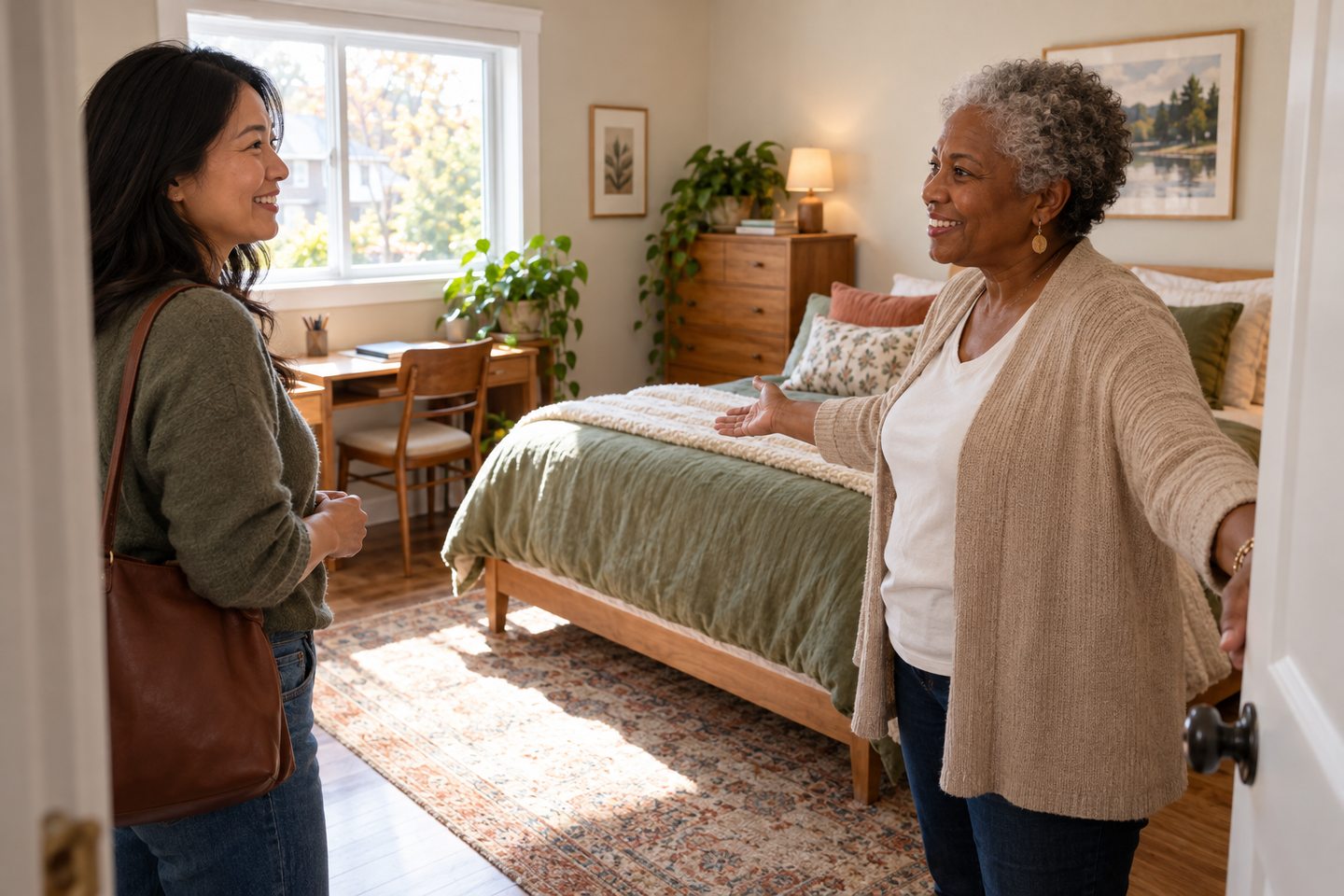
Begin with a home, not just a room
The first months of sharing a home are an opportunity to turn an available bedroom into a workable everyday arrangement. The benefits can reach beyond a contribution to household costs. A well-organized shared home can offer independence, occasional companionship and a welcoming place in an established neighbourhood. Those benefits grow through ordinary details: somewhere to put groceries, a reliable way to report a repair, and confidence that closing a bedroom door will be respected. Hosting becomes easier when these practical foundations are considered before move-in day.
A first ninety days plan gives you a useful rhythm for learning and adjusting. It is not a probation period or a shortcut around anyone's rights. The agreement and applicable law determine the arrangement, including how it can change or end. Think of the timeline as three stages: preparing carefully, settling into routines, and reviewing what makes the home sustainable. You do not need to create instant friendship or a perfectly polished household. You need a clear welcome and a fair way to work through everyday questions.
Before day one: explain the actual arrangement
Start by describing what a person would really be renting. Show the private room and the shared areas, and explain any genuine limits on access. Discuss bathrooms, storage, cooking, laundry, work calls, parking and outdoor space. An attractive description should still be accurate about stairs, noise and the layout. If the home has a particular community focus, explain the relevant household practices plainly and respectfully. Invite practical questions without asking someone to disclose private medical information or treating identity as a shortcut for compatibility.
Clarify the legal form of the arrangement before relying on a generic agreement. In Ontario, some owner-shared kitchen or bathroom arrangements fall outside the Residential Tenancies Act, while other room rentals may be covered. The facts matter, and a label such as Bunkmate does not decide the legal position. Obtain appropriate guidance for your specific home. The preparation should produce clear terms about payments, responsibilities, access and applicable processes, giving both people a dependable reference instead of leaving important questions to memory or informal assumptions.
Prepare for an adult with an independent life
Clear enough storage for the incoming person's belongings in every area they are expected to use. A bedroom wardrobe is helpful, but so are a kitchen shelf, refrigerator space and a practical place for shoes or outerwear. Make sure the room and agreed common areas are clean and ready when promised. Explain any unfinished work honestly and complete essential work before occupancy. A thoughtful welcome does not require gifts or elaborate decoration; it requires making physical room for someone else's daily life in the home.
Consider how information will be shared. A short, readable household guide can explain internet access, waste collection, appliance use, maintenance contacts and emergency procedures. Offer to discuss it aloud rather than assuming everyone prefers a written document. Clear language helps people with different first languages and communication preferences. Keep private information out of publicly visible instructions. A useful guide answers ordinary practical questions without turning into a lengthy book of personal preferences that makes the newcomer feel watched before they have even unpacked their belongings.
Move-in day: make the first hours manageable
Plan a reasonable arrival window together and explain the easiest way to bring belongings inside. If the route includes stairs or narrow doorways, describe those in advance. Confirm keys or other access arrangements and demonstrate anything that is genuinely difficult to operate. Show the person their room, storage and essential facilities first. Avoid filling the arrival with every possible conversation. Someone moving home may be tired, preoccupied or simply ready for private time, and an unhurried welcome gives them permission to settle at their own pace.
Walk through relevant safety information and how to report urgent problems. Show agreed exits and explain the household's emergency arrangements without suggesting that another resident becomes responsible for supervision or personal care. If professional assistance is needed in an emergency, ordinary emergency services remain the appropriate resource. A Bunkmate is an independent adult, not a built-in responder. Finish the orientation with one clear invitation: practical questions are welcome. Then allow some quiet space so the home begins to feel usable rather than like an extended interview.
Week one: let routines become visible
During the first week, expect small surprises. Two people may both use the kitchen at the same time, prefer different room temperatures or have different definitions of a cleared counter. These discoveries are useful information rather than evidence of failure. Ask about the practical issue directly and describe its effect without attaching a character judgment. “We both seem to need the stove around six; how can we make that easier?” opens a better conversation than implying someone is inconsiderate for using an agreed shared facility.
Notice which routines actually need coordination and which can remain independent. Not every meal, outing or laundry load requires discussion. The aim is enough predictability to make the home comfortable, with enough freedom for both people to live normally. If you enjoy offering tea or a meal, make the invitation easy to decline. Warmth feels different when it is optional. The possibility of connection is one of shared living's benefits, but a quiet evening alone should be just as legitimate as a conversation in the kitchen.
Make the kitchen easy to share
A kitchen works better when people can understand the system without repeated negotiation. Agree on storage, shared equipment and what should be cleaned after use. Discuss how long dishes can reasonably remain out and where food is kept. Ask about practical requirements without demanding an explanation of personal beliefs or health conditions. Someone may need separate cookware, prefer their own groceries or have a different meal schedule. Start with what helps each person use the space safely and comfortably, then find a workable approach together.
Shared meals can be enjoyable, but they need a separate conversation about cost and effort. Do not assume rent includes buying groceries for others, cooking on a schedule or providing company at dinner. A simple invitation to occasionally share food is often more sustainable than an ambitious household meal plan. If both people want a recurring arrangement, write down what it involves and revisit it when schedules change. The benefit comes from making everyday life easier, not from adding invisible obligations that gradually become sources of frustration.
Protect private time and shared comfort
Privacy is one of the foundations that makes togetherness enjoyable. Establish a clear practice of knocking and respecting private rooms, consistent with the legal access rules for the arrangement. Do not borrow belongings, enter personal storage or expect explanations for ordinary comings and goings. Shared living should not require a person to narrate their day. The Host also needs protected personal space. When those boundaries are understood, both people can use common areas with less anxiety about accidentally intruding or being expected to socialize.
Discuss sound in terms of practical effects: work calls, music, television, early starts and sleep. Aim for reasonable expectations that apply fairly, rather than assuming one person's schedule always takes priority because they own the property. Headphones, furniture placement and agreed quiet practices may solve more than repeated reminders. Where the layout makes competing needs difficult, acknowledge that honestly. A clear conversation can reveal whether a modest adjustment is enough or whether the proposed use of a room needs more careful thought and appropriate guidance.
Talk about guests before a problem develops
Guests are part of ordinary adult life, so discuss expectations early and check that any proposed terms are lawful for the arrangement. Focus on matters that affect shared living: noise, common areas, security and communication about situations that meaningfully change use of the home. Avoid turning practical coordination into control over another person's relationships. The Host should consider the effect of their own visitors as well. A shared expectation feels fairer when it is reciprocal and relates to the actual needs of the household.
A useful conversation might explore how to handle a larger gathering, a visitor arriving while someone is working, or a guest who does not know the kitchen routine. Agree how to raise a concern without embarrassment in front of others. Do not assume a friendly discussion can override applicable rights or an existing agreement. When uncertainty concerns legal restrictions rather than everyday courtesy, get guidance. Keeping those questions distinct helps the home remain welcoming while giving both residents a respectful way to protect their rest and comfort.
Weeks two to four: create a small check-in habit
After the initial settling period, suggest a brief conversation at a mutually convenient time. Ask what is working, what is unclear and whether any practical adjustment would help. Keep it focused enough that it does not feel like a performance review. A person should be able to mention a squeaking door, limited storage or uncertainty about recycling without worrying that an ordinary request threatens their housing. Listen before offering a solution. Often the most useful change is small and inexpensive once the actual problem is understood.
Record agreed practical changes in a short message so neither person has to remember everything. Distinguish routine coordination from formal changes to the housing agreement, which may require a different process. Avoid using a check-in to introduce surprise fees or new restrictions. Its purpose is to make the existing arrangement work better. If there is nothing significant to discuss, a short confirmation that things are going well is enough. Predictable, low-pressure communication can prevent the accumulation of minor annoyances that otherwise make a household feel unnecessarily tense.
Month two: share tasks without creating hidden employment
As the home settles, clarify responsibility for ordinary shared-area tasks. Some households prefer a simple rotation; others divide tasks by preference or pay for an agreed service where appropriate. The important part is that expectations are explicit and consistent with the agreement and applicable obligations. Do not assume a Bunkmate will provide repairs, transportation, personal care or substantial household labour because they are younger, handy or available during the day. Those are separate responsibilities, and casual generosity should not become a condition that was never discussed.
A routine should also accommodate real life. Someone may travel, work an unusual shift or temporarily have less energy. Agree on a straightforward way to communicate about an unfinished shared task without asking for private details. The purpose of coordination is a usable home, not perfect symmetry in every week. If a task is important for safety or maintenance, the responsible person must ensure it is handled appropriately. A flexible but clear system protects the benefit of sharing: less friction around ordinary chores and more space for daily life.
Make inclusion practical every day
Inclusive hosting is expressed through actions rather than a statement in a listing. Learn how to pronounce someone's name, ask how they prefer to receive practical messages, and explain unfamiliar household systems without condescension. Do not infer habits from age, disability, culture or family structure. Ask the relevant question directly: what storage is needed, which route is usable, or what makes a shared space comfortable? Let people describe their needs themselves. Honest information about the home gives a prospective Bunkmate a better basis for making their own decision.
Where a home welcomes people seeking Senior Living, Accessible Living or Dry Living, be specific about what the setting offers. A community label is not proof of physical accessibility, a care service or a recovery program. Describe real features and agreed practices, and avoid making promises beyond the household's capacity. People can benefit from shared values and a welcoming environment while remaining fully independent. The most sustainable welcome respects that difference, creating opportunities for connection without expecting personal disclosure, emotional labour or participation in a particular social routine.
Month three: notice the wider benefits
By the third month, you may begin to see benefits that were difficult to predict from a listing. A previously unused room now supports someone's daily life. An established neighbourhood becomes home to another person. You may enjoy occasional conversation or find that managing household routines has become more intentional. These are possibilities rather than guaranteed outcomes, but they are worth noticing. A successful arrangement does not have to become a close friendship to matter; calm coexistence and a dependable place to live are valuable results themselves.
Invite, rather than prescribe, connections beyond the house. You might share information about nearby shops, libraries, parks, transit or community activities, while leaving the Bunkmate free to explore independently. If an introduction to a neighbour would be welcome, ask first. Belonging grows when a person can choose their own relationships and routines. The wider community benefits when homes are used thoughtfully and newcomers are treated as neighbours. That does not require the household to organize a social program; ordinary respect and useful local information can be enough.
Review the first ninety days with a long view
At the end of the period, revisit the reasons you chose to share. Is the financial contribution useful? Are common areas comfortable? Do both people have enough privacy and a clear way to raise concerns? Check your own workload as well. If hosting feels demanding, identify the source rather than assuming the whole idea has failed. A confusing payment process, inadequate storage or an overambitious meal routine may be easier to improve than it first appears. Use specific observations and keep any changes consistent with existing commitments.
The first ninety days are a beginning, not a test someone passes or fails. Continue the routines that help, simplify the ones that do not, and seek appropriate help for issues beyond an ordinary household conversation. Bunking can introduce the idea of shared living, while the people in the home create its everyday character. A sustainable arrangement gives each person a place to belong without giving up their independence. That balance is what turns a room rental into a shared home worth taking care of together.